
 0 minutes
Europe is entering a new era of border control that is Schengen EES system 2026.
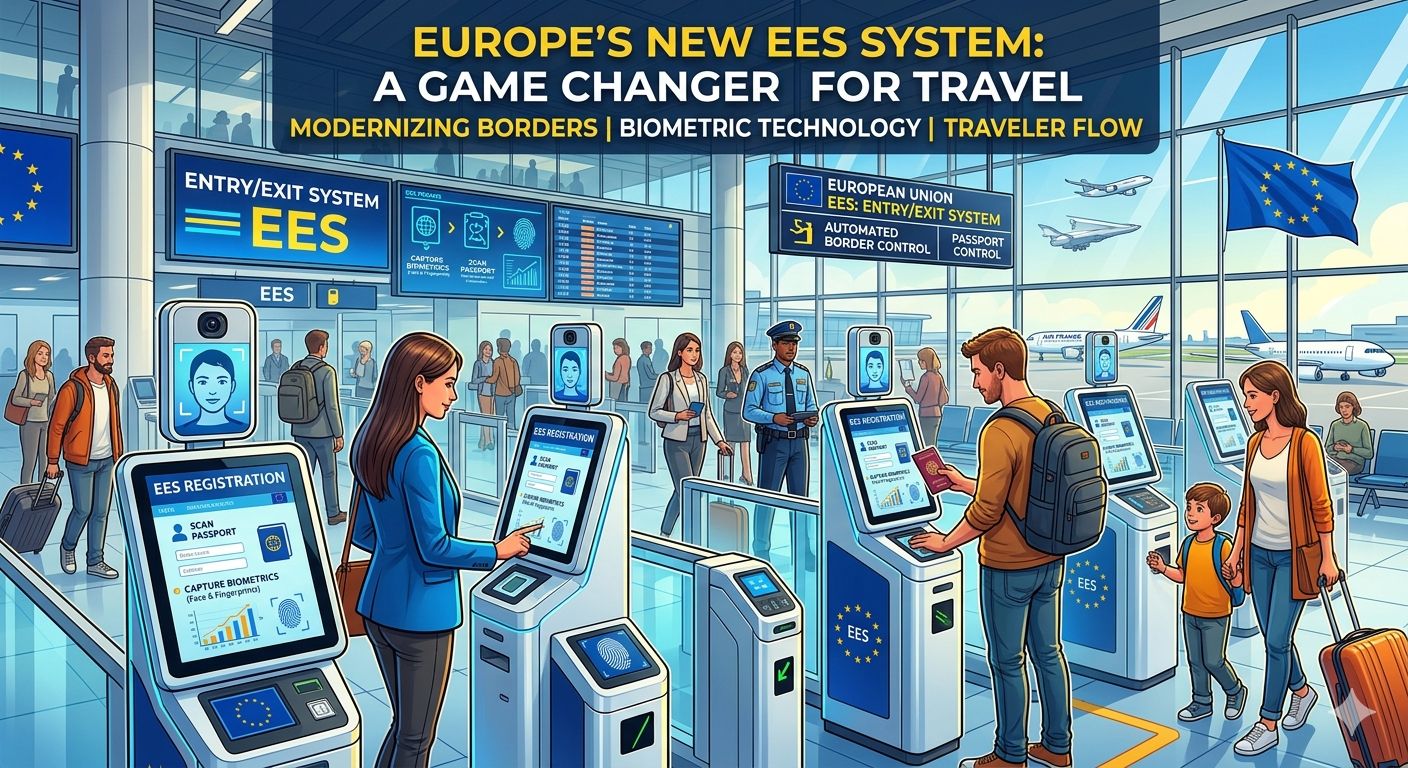
From April 10, 2026, the European Union will officially implement the Entry/Exit System (EES), a digital border management system that replaces traditional passport stamping with biometric tracking and automated data recording.
This is one of the biggest changes to European travel in decades. Whether you’re a tourist, business traveler, or visiting family, this system will directly affect how you enter and exit the Schengen Area.
In this detailed guide, you’ll learn:
What the EES system is
Why it’s being introduced
How it works step-by-step
Its impact on visas and travel
Tips to avoid delays or rejection
Also Read: What is Schengen Visa?
The Entry/Exit System (EES) is a centralized digital system designed to register non-EU travelers entering and leaving the Schengen Area.
Instead of stamping passports, border officials will now collect and store:
Entry and exit records
Biometric data (fingerprints and facial images)
Travel history
This system is being implemented by the European Commission as part of a broader plan to modernize border security and reduce illegal immigration.
👉 Official Source: Here
The EES system will officially go live on:
👉 April 10, 2026
However, rollout may vary slightly depending on airports and countries. Some locations may introduce it in phases, meaning travelers could experience mixed procedures initially.
The system applies to all countries in the Schengen Area, including:
France
Germany
Italy
Spain
Netherlands
Switzerland
Austria
Belgium
In total, more than 25 European countries will adopt this system across:
Airports
Land borders
Seaports
The EES system targets short-stay travelers from non-EU countries.
Tourists
Business visitors
Short-term students
Family visitors
Visa-free travelers
EU citizens
Residents with long-term permits
National visa (Type D) holders
The traditional passport stamping system has several limitations:
Manual errors in stamping
Difficult to track overstays
Time-consuming border checks
Lack of centralized data
Fully automated digital tracking
Accurate stay calculation
Faster processing in long term
Improved data sharing across countries
The system also strengthens enforcement of the 90/180-day rule, which limits how long travelers can stay in the Schengen Area.
Understanding how the system works will help you avoid confusion at the airport.
When you travel to Europe for the first time after EES launch:
Present your passport
Provide fingerprints
Take a facial scan
Border officer verifies your identity
Your entry is recorded digitally
This process may take slightly longer than usual.
For future trips:
Your biometric data will already be stored
Entry process will be faster
Automated gates may be used
When leaving the Schengen Area:
Your exit will be recorded automatically
No passport stamp required
Biometric collection is a key part of the EES system.
Fingerprints
Facial image
Biometric data is typically stored for up to 3 years, meaning you won’t need to provide it again during that period.
The European Union ensures strict data protection rules under GDPR.
One of the biggest impacts of EES is strict overstay monitoring.
Previously, overstays could sometimes go unnoticed due to manual stamping errors.
With EES:
Every day is tracked automatically
Overstays are instantly flagged
Authorities across Europe can access your travel history
Fines
Visa rejection
Entry bans
Difficulty getting future visas
Yes — especially in the early months.
Longer waiting times
Biometric registration delays
Confusion among travelers
Faster repeat entries
Automated border gates
Reduced manual checks
No need to track stay days manually
Faster future border crossings
Increased transparency
Better immigration control
Reduced illegal stays
Stronger security systems
The EES system is often confused with ETIAS.
Here’s a simple breakdown:
|
Feature |
EES |
ETIAS |
|---|---|---|
|
Purpose |
Track travel |
Travel authorization |
|
Implement |
April 2026 |
Upcoming |
|
Applies to |
All non-EU travelers |
Visa-free travelers |
👉 Learn more: Visit here
To avoid problems under the new system:
Check passport validity (minimum 6 months)
Book confirmed return tickets
Carry accommodation proof
Arrive early (especially first trip)
Follow biometric instructions carefully
Overstaying your visa
Giving incorrect information
Ignoring entry/exit records
Yes, all non-EU travelers must follow EES rules.
Yes, it will be replaced by digital records.
No, usually valid for 3 years.
No, visa rules remain unchanged.
It will be automatically detected and may lead to penalties.
The EES system might feel complicated at first, but it’s ultimately designed to improve travel efficiency and security.
Yes, your first trip after April 2026 may involve:
Longer queues
Biometric registration
Extra verification
But after that, your travel experience will likely become smoother and faster.
For frequent travelers, this system is actually a long-term advantage.