 0 minutes
By Bluebird Next | bluebirdnext.com | Updated: April 2026
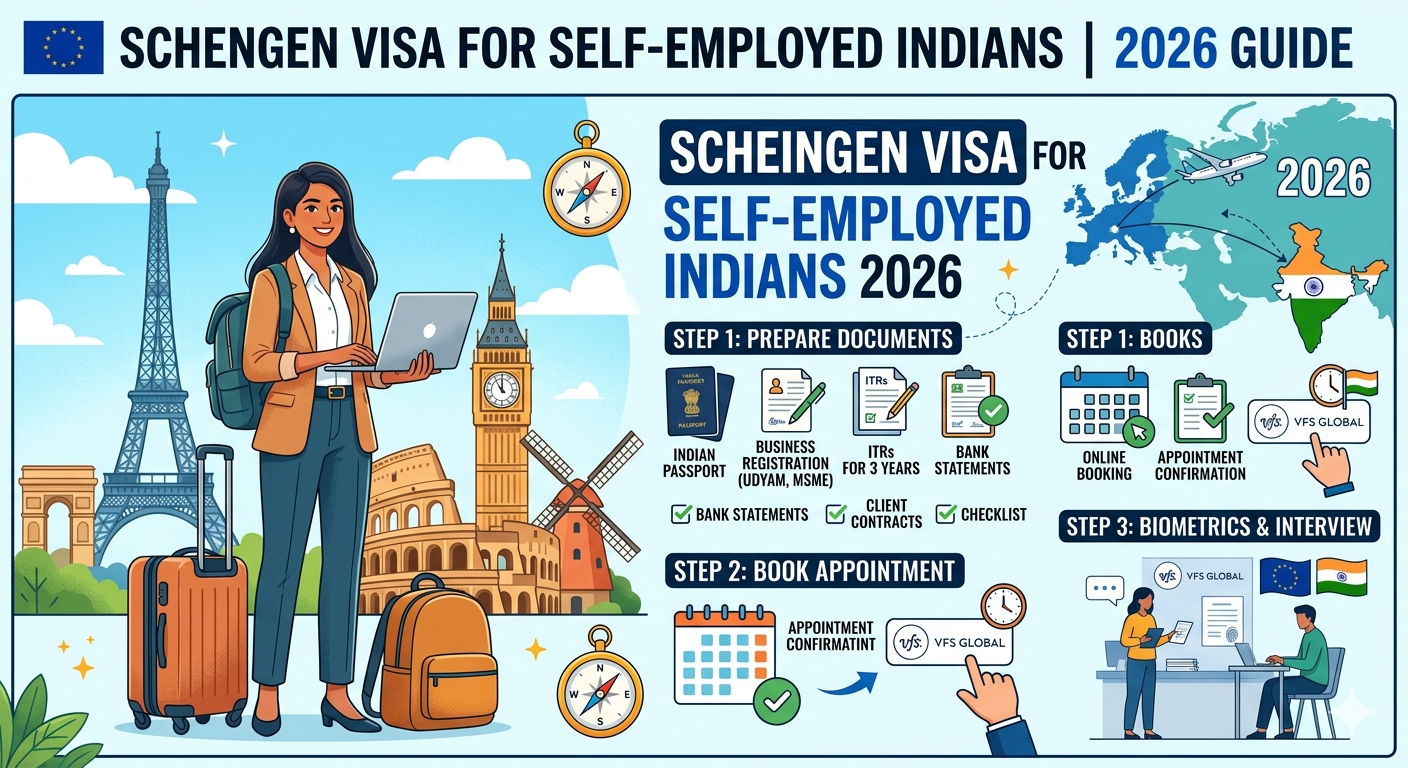
Applying for a Schengen visa for self-employed Indians in 2026 is not difficult — but it is different. If you are a business owner, freelancer, trader, or consultant planning a Europe trip, you cannot apply the same way a salaried person does. Consulates ask for more documents, check your ITR, GST certificate, and bank statements more carefully, and look specifically for proof that you will return to India. This complete guide tells you exactly what to prepare, what consulates check, and how to get your Schengen visa approved the first time.
| Detail | Information |
|---|---|
| Who This Is For | Business owners, freelancers, consultants, traders, sole proprietors |
| Stay Allowed | Up to 90 days in any 180-day period |
| Minimum Recommended Balance | ₹2.5 lakh to ₹4 lakh depending on trip length |
| ITR Required | Yes – last 2 to 3 years (personal + company both) |
| GST Certificate Required | Yes – for registered businesses |
| Rejection Risk | 30 to 40% higher than salaried applicants if documents are weak |
| Visa Fee | €90 for adults (approx. ₹8,100) |
When a salaried person applies for a Schengen visa, the process is relatively straightforward. Salary slips, an employment letter, and a bank statement tell the full story in three documents. A visa officer can see stable income, a job to return to, and funds for the trip.
For self-employed applicants who are applying for Schengen visa — whether you run a shop in Karnal, consult clients as a freelancer in Bangalore, or own a trading business in Delhi — none of those easy documents exist. There is no employer to vouch for you. There is no fixed salary credit every month. And in the eyes of the consulate, there is no fixed job pulling you back to India after the trip.
This is why self-employed Indians face a rejection rate 30 to 40 percent higher than their salaried counterparts. But here is the truth — thousands of business owners and freelancers get Schengen visas approved every single month. The difference is preparation and presentation.
To get approved, you must prove three things clearly. First, your business is real and legitimate. Second, you are financially stable and can fund the trip. Third, you have strong reasons to return to India. Every document you submit should prove one of these three things.
The bank statement is the most scrutinized document in any Schengen application. For self-employed applicants, it carries even more weight because there are no salary slips to back it up. Here is exactly what consulates check in 2026 and what you must do.
They check consistency, not just the closing balance. A balance of ₹3 lakh sitting in your account for 4 to 6 months tells a completely different story than ₹3 lakh that appeared two days before your VFS appointment. Consulates look at your monthly opening and closing balances, regular credits, and the overall pattern of your account over time.
Sudden large deposits are an instant red flag. If your account shows ₹40,000 most months and then suddenly shows ₹2.5 lakh just before application, the visa officer will assume you borrowed that money to inflate your balance. This is one of the top rejection triggers for self-employed Indians. The solution is simple — start building your balance at least 3 to 4 months before you apply and let genuine income accumulate naturally.
Submit both personal and business accounts. This is the most common mistake. Many applicants only submit their business current account. But consulates need to see money in your personal savings account — the account you will actually use to pay for your trip. Your current account shows business turnover. Your savings account shows personal financial stability. Submit both, always.
Show 6 months of statements, not 3. Variable income is normal for self-employed people. Showing 6 months allows the officer to calculate your average monthly income and understand your financial pattern. Three months is too short and creates uncertainty.
Passbook copies are not accepted. Germany, Switzerland, France, and several other Schengen embassies explicitly reject passbook photocopies and online statements without bank stamps. Get your bank to print, stamp, and sign each page of your statement. This is non-negotiable.
How much balance do you need? The general guideline is €50 to €100 per person per day of travel. For a 10-day trip, that means roughly ₹50,000 to ₹90,000 in actual trip funds. However, for self-employed applicants, maintaining a higher overall balance is strongly recommended — at least ₹2.5 to ₹4 lakh in your savings account — to compensate for the absence of salary proof.
Most applicants believe that as long as they submit all documents, everything is fine. In 2026 that is no longer the full picture. Under Article 21 of the EU Visa Code, consulates have the legal right to contact third parties to verify your information without informing you. This means they can call your bank to verify statement authenticity, check GST portal records to confirm your registration is active, cross-check ITR filings, and even contact listed clients to verify business relationships.
The most important consistency check is between your ITR income and your bank statement income. If your bank credits show ₹4 lakh per month but your ITR declares only ₹3 lakh annual income, this creates a serious red flag. Your declared tax income, your bank credits, and the income figure you mention in your cover letter must all tell the same consistent story.
Your GST registration must also be active at the time of application. Submitting a GST certificate that belongs to an inactive or cancelled registration is treated as a fraudulent document and can lead to a permanent ban.
For a salaried person, the cover letter is helpful. For a self-employed person, it is essential. This is your chance to explain everything that your documents cannot say on their own.
A strong cover letter for self-employed applicants must include: your name and profession, a brief description of your business including registration details and GST number, your average monthly income and current bank balance, your complete travel plan and purpose of visit, and most importantly — clear reasons why you will return to India after the trip.
That last point matters more than anything else. Mention your ongoing business contracts, your registered company that requires your presence, your family in India, any property you own, and specific business commitments that await you after your return. The consulate needs to believe, without any doubt, that your life and livelihood are firmly rooted in India.
Keep the letter to one A4 page. Print it on company letterhead if you have one. Sign it personally. Make it specific — generic letters that say “I am visiting for tourism and will return” are weak and unconvincing.
Mistake 1: Submitting only the business current account and skipping the personal savings account. Always submit both.
Mistake 2: A sudden large deposit just before applying. Build your balance months in advance.
Mistake 3: ITR income and bank statement income do not match. Keep all financial figures consistent across every document.
Mistake 4: Inactive or cancelled GST registration. Verify your status on the GST portal before applying.
Mistake 5: No proof of ongoing business operations. An old GST certificate alone is not enough. Show active client contracts and recent invoices to prove your business is running today.
Being self-employed does not make you ineligible for a Schengen visa. It just means you need to work harder on your application. Where a salaried person submits 3 to 5 documents to prove income and stability, you will submit 12 to 18 documents to prove the same things. But when done right, the result is exactly the same — a Schengen visa stamp and a trip to Europe.
Think like a visa officer when building your file. Every document must prove one of three things: your business is legitimate, you are financially stable, and you will return to India. When your application clearly proves all three, approval follows.
At Bluebird Next, we help self-employed Indians — business owners, freelancers, traders, and consultants — build Schengen visa applications that get approved. Contact us for a free document review before you apply.
Website: bluebirdnext.com | YouTube: @bluebirdnext – Serving Self-Employed Indians Across India
Disclaimer: Visa requirements vary by Schengen country. Always verify the latest checklist from the specific embassy before applying. This article is for informational purposes only.