
 0 minutes
For first-time international travellers, applying for a Schengen Visa can feel overwhelming because there is no single document that guarantees approval. The strongest application is usually one where the documents tell a clear, consistent story: why you are travelling, how you will pay for the trip, where you will stay, and why you have good reasons to return home.
For applicants from India and other countries, exact requirements can vary according to the destination country and individual circumstances. EU visa rules require applicants to provide evidence covering the purpose and conditions of the trip, accommodation, sufficient means of subsistence and the intention to leave before the visa expires.
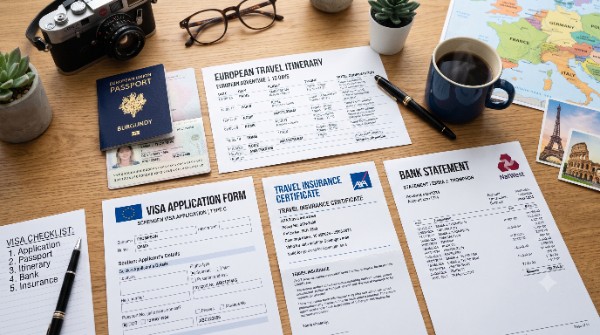
Think of your application as a chain. Your passport establishes your identity, your itinerary explains the journey, your accommodation supports where you will stay, your financial documents demonstrate affordability, and your employment or other personal documents can help explain your circumstances at home.
The most important documents generally include:
Valid passport and visa application documents
Travel itinerary and evidence of the purpose of the trip
Accommodation proof
Proof of sufficient financial means
Travel medical insurance, where required
Evidence of employment, business, study or other circumstances
Documents supporting your intention to return
Additional documents required by the specific consulate or visa centre
EU rules specifically require evidence of the journey’s purpose, accommodation, sufficient means of subsistence and information allowing authorities to assess whether the applicant intends to leave the Schengen area before the visa expires.
The important point is that documents should support one another. A bank statement showing money is useful, but it becomes much more meaningful when the income, employment, travel costs and itinerary are also understandable.
One of the most common concerns for first-time travellers is the Schengen visa proof of funds.
There is no universal single bank-balance figure that applies identically to every Schengen application. The assessment of sufficient means depends on factors including the duration and purpose of the stay, the relevant country’s reference amounts and the circumstances of the applicant. EU rules state that means of subsistence are assessed with reference to the duration and purpose of the stay and relevant costs in the Member State or States concerned.
That means simply trying to maintain an artificially high balance shortly before applying is not necessarily a good strategy.
Where your money comes from
Whether your income is regular and credible
Whether you can reasonably afford the proposed trip
Whether the trip’s cost matches your financial circumstances
Whether unusual transactions can be explained
Whether your documents are consistent with the information in your application
For applicants in India, the exact documentary checklist should always be checked against the relevant consulate and visa application centre instructions. For example, the VFS Global information for Switzerland in India states that applicants should follow the official harmonised checklist and, for that application route, submit stamped and signed bank statements covering the last three months.
Step-by-Step: Build a Strong Document File
Step 1: Start With the Correct Consulate and Checklist
Before collecting documents, determine which Schengen country is responsible for your application.
Do not simply choose a consulate because you believe it may be easier. Your application should reflect your genuine travel plans and the applicable jurisdiction.
Once you know where to apply, download or review the current official checklist for your visa category. Requirements can differ according to nationality, residence, purpose of travel and individual circumstances.
If a visa centre is involved, remember that it generally provides administrative services; the underlying visa requirements come from the relevant government or consular authority. VFS Global’s Italy information for India, for example, instructs applicants to identify the correct visa type and follow the guidelines applicable to that category.
Step 2: Make Your Travel Story Easy to Understand
Your itinerary should answer basic questions without forcing the visa officer to reconstruct your trip.
Show:
Intended arrival and departure dates
Cities or countries you plan to visit
Accommodation arrangements
Main purpose of the trip
Internal travel arrangements where relevant
How the trip connects with your leave from work, studies or other commitments
Avoid creating an unnecessarily complicated itinerary simply to include more destinations.
A shorter, realistic trip that matches your budget and available leave can be easier to understand than an ambitious multi-country itinerary with little supporting evidence.
Step 3: Prepare Your Bank Statements Carefully
Your bank statement is not merely a document showing a final balance.
The transaction history can help demonstrate the financial pattern behind the balance. Visa officers may need to understand whether the funds are consistent with your normal financial circumstances.
The required statement period
Whether the statement must be stamped or signed
Whether online statements are accepted
Whether salary credits are visible
Whether the account holder’s name matches the application
Whether large or unusual transactions need supporting evidence
Whether the balance reasonably supports the proposed travel expenses
Do not alter, hide or manipulate transactions. Authenticity and consistency are more important than trying to make the statement look perfect.
How to Explain Large Deposits for a Schengen Visa
A large deposit is not automatically a problem. The issue is whether the transaction is genuine, lawful and understandable.
For example, suppose your normal monthly account activity is relatively stable, but a large credit appears shortly before your visa application. A reviewer may reasonably want to understand where that money came from and whether it is actually available for your trip.
A documented annual bonus
Sale of a vehicle or other asset
Transfer between your own accounts
Fixed-deposit maturity
Refund from an investment
Business income supported by records
Documented family support
Other legitimate, traceable sources
The appropriate supporting evidence depends on the transaction.
What Should a Large Deposit Explanation Include?
If a significant transaction genuinely needs clarification, a concise large deposit explanation letter for visa can help connect the bank statement to the supporting evidence.
The amount and date of the deposit
The genuine source of the money
Why the money was received
Supporting documents attached
Whether the funds are available for the proposed trip
For example, if the money came from the sale of an asset, supporting documentation might include evidence of the transaction and receipt of funds, where applicable.
If the money was transferred from another account belonging to you, statements from the originating account may help demonstrate that it is an internal transfer rather than unexplained new income.
Do not create a story simply to explain a transaction. Explain the real transaction and provide evidence.
Do You Need a Schengen Visa Bank Statement Cover Letter?
A Schengen visa bank statement cover letter is not a substitute for proper financial documentation.
Its purpose, where appropriate, is to make a complicated financial situation easier to understand. It can be particularly useful when there are unusual transactions, multiple accounts, recent asset sales, irregular income or financial support from another person.
Keep it factual and short.
Section What to Explain
Applicant details Name and passport/application reference where appropriate
Trip Travel dates and destination
Financial position Main source of income and available funds
Unusual transaction Amount, date and genuine source
Supporting evidence Documents attached to verify the transaction
Closing Confirmation that the information is accurate
A cover letter should clarify evidence, not compensate for missing evidence.
Step 4: Connect Your Finances With Your Circumstances
A strong application does not rely on money alone.
Your financial documents should make sense alongside your personal circumstances.
For an employed applicant, this may include appropriate employment evidence, approved leave and salary information.
For a business owner, business registration, tax or financial records and other relevant evidence may help demonstrate the nature of the business.
For a student, documents relating to studies and sponsorship may be relevant.
For a sponsored traveller, the applicable sponsorship documents should clearly establish who is providing financial support and what expenses they will cover.
The precise documents depend on the applicant and destination country, so use the applicable official checklist rather than relying on a generic internet list.
Best Practices for First-Time International Travellers
Start with the official checklist. Generic document lists are useful for orientation but cannot replace destination-specific requirements.
Keep your story consistent. Dates, destinations, accommodation, leave dates and financial information should not contradict one another.
Explain unusual transactions proactively. A short factual explanation supported by evidence can be clearer than leaving a significant transaction unexplained.
Avoid unnecessary documents. More paperwork does not automatically mean a stronger application. Submit relevant evidence requested or reasonably needed to explain your circumstances.
Keep copies of everything. Maintain a digital and physical record of submitted documents where practical.
Check document format requirements. Some application routes have specific rules about signatures, stamps, translations, validity periods or document language. For example, VFS Global notes that certain documents for Italian visa applications in India may require translation depending on the checklist.
A large balance may look impressive, but unexplained recent funds can create questions.
Better approach: demonstrate the genuine source with appropriate supporting evidence.
Moving or borrowing money solely to make an account balance appear stronger can create an inconsistent financial picture.
Better approach: present your genuine financial position and explain legitimate transactions.
If your application says you will spend ten days in France but your accommodation, flights and financial calculations suggest something completely different, the overall story becomes harder to follow.
Better approach: check every date and destination across the application before submission.
A beautifully written explanation cannot replace evidence that the checklist requires.
Better approach: treat the cover letter as a supporting document, not the foundation of your application.
Visa procedures and document requirements can change.
Better approach: verify the current requirements immediately before preparing your application.
Latest Schengen Updates for 2026
There is an important change first-time travellers should know about when planning their Europe trip.
The EU’s Entry/Exit System (EES) became fully operational on 10 April 2026. It digitally records relevant entry and exit information and biometric data for eligible non-EU nationals travelling for short stays, replacing the previous passport-stamping process at the external borders.
This does not replace the Schengen Visa application process. It is a border-management system used when eligible travellers enter and leave the Schengen area.
Another upcoming development is ETIAS, which concerns visa-exempt travellers rather than people who require a Schengen Visa. The European Commission currently says ETIAS is scheduled to start in the last quarter of 2026, with the exact launch date to be announced officially.
A Practical Schengen Visa Document Checklist
Before submitting your application, ask yourself:
Document area Key question
Passport Is it valid and suitable for the application?
Application Have all details been completed consistently?
Itinerary Does it clearly explain the trip?
Accommodation Do bookings match the stated dates and locations?
Finances Do the documents demonstrate genuine accessible funds?
Bank transactions Can unusual deposits or transfers be explained?
Employment/business/study Does your evidence accurately reflect your circumstances?
Insurance Does it meet the applicable requirements?
Supporting documents Have you followed the specific checklist?
Copies/translations Are the required formats and translations prepared?
The goal is not to create the thickest possible application file. The goal is to create a credible, coherent and well-supported application.

October 22, 2026

October 19, 2026

October 16, 2026
October 12, 2026

October 10, 2026