
 0 minutes
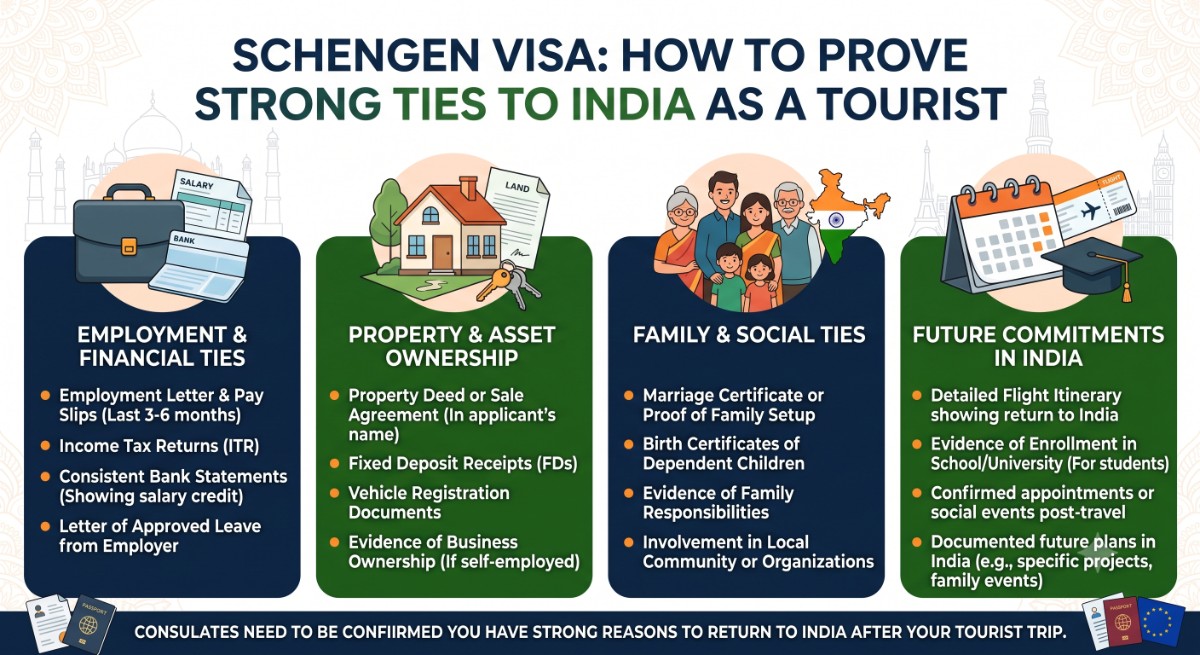
If you are applying for a Schengen Visa from India, one important part of your application is demonstrating that your trip is genuinely temporary and that you have credible reasons to return to India. Strong ties do not mean that you must own property, have a very high salary or have a large bank balance.
Instead, visa authorities can look at your professional, financial, family, educational and social circumstances together. Employment, an active business, ongoing studies, family responsibilities, property and established financial activity can all help explain your connection to India.
The key is consistency. Your application form, cover letter, bank statements, employment documents, itinerary and other supporting evidence should present a clear and believable picture of your circumstances.
“Strong ties” generally refers to genuine circumstances that connect you to your country of residence and support your intention to leave the Schengen Area after your authorised stay.
The EU Visa Code specifically allows authorities to assess information concerning an applicant’s intention to leave before the visa expires. Supporting evidence can include financial means in the country of residence, employment, property, family ties and professional status. (EUR-Lex)
There is therefore no single document called a “strong ties certificate.”
Instead, your application should demonstrate your circumstances through relevant evidence.
For example:
The objective is not to create artificial ties. It is to clearly document the genuine ties you already have.
A tourist visa application is assessed as an individual application. Authorities need enough information to assess the purpose and conditions of the proposed trip and the applicant’s intention to leave the Schengen Area before the visa expires.
Under the EU Visa Code, supporting documents can be used to assess the applicant’s intention to leave. The European rules specifically identify evidence such as financial means, employment, property, family ties and professional status. (EUR-Lex)
This means your application should tell a consistent story:
Who are you? → Why are you travelling? → How will you pay? → What do you do in India? → What brings you back after the trip?
For example, if you are a full-time employee in India, have approved leave for 12 days and have planned a 10-day European holiday, those elements can logically support each other.
The important point is that strong ties are only one part of the overall visa assessment. They do not guarantee approval.
For salaried employees, employment can be an important part of demonstrating professional and economic ties.
Depending on the specific destination country’s checklist, useful documents may include:
For example, the Netherlands’ official checklist for applicants applying for a tourist Schengen Visa in India asks employed applicants for an employment contract, a recent employer letter approving leave and payslips from the previous three months. (NetherlandsWorldwide)
Your employment evidence should be consistent with the information in your application.
If your job title, salary, employment dates or leave period differ across documents, explain any genuine discrepancy rather than leaving it unexplained.
If you are self-employed or operate a business in India, your business can demonstrate an ongoing professional connection.
Depending on your situation and the destination country’s requirements, documents may include:
For example, the Netherlands’ India tourism checklist specifically lists a company registration certificate, GST registration number for an Indian company, business bank statements and a verified-barcode income tax return for self-employed or company-owner applicants. (NetherlandsWorldwide)
The purpose is not to submit every business document you have. Select documents that clearly demonstrate that your business is genuine and ongoing.
Family circumstances can also contribute to your overall evidence of ties.
Depending on your circumstances, this may include:
For example, official guidance for tourist applicants in India identifies evidence of children attending school in the country of residence or documentation showing caregiving responsibilities as possible evidence of social or economic ties. (NetherlandsWorldwide)
However, family documents should be relevant to your situation. Do not submit sensitive or unnecessary documents simply to increase the size of your application.
If you own residential property, land or other real estate in India, it may provide additional evidence of your economic connection to the country.
Possible documents can include:
The EU Visa Code specifically identifies proof of real estate property as one type of supporting evidence that may assist with assessing an applicant’s intention to leave the Schengen Area. (EUR-Lex)
But property ownership is not a universal requirement for a Schengen tourist visa.
An applicant who rents a home but has stable employment, genuine finances and other established commitments can still demonstrate strong ties through those circumstances.
Students should clearly demonstrate that they are continuing their education in India.
Supporting documents may include:
The Netherlands’ official checklist for applicants in India states that students should provide a statement from the educational institution where they are enrolled. (NetherlandsWorldwide)
If you are travelling during a university holiday, make the timing clear. Your travel dates should make sense alongside your academic calendar.
A bank balance is important for demonstrating that you can potentially fund your trip, but a large bank balance alone does not prove strong ties to India.
Financial evidence should ideally show where your money comes from and how your finances normally operate.
For example, a salaried employee might show:
Regular salary credits → normal monthly expenses → accumulated savings → reasonable travel expenditure
The Netherlands’ tourism checklist for India asks for personal bank statements from the previous three months and accepts income tax return evidence as part of demonstrating financial means. (NetherlandsWorldwide)
The EU Visa Code also requires information concerning sufficient means of subsistence and information that allows authorities to assess the applicant’s intention to leave. (EUR-Lex)
A healthy application is not necessarily the one with the biggest bank balance. It is the one where the financial story is genuine, understandable and consistent.
Before collecting documents, make a simple list of your actual connections to India.
For example:
Do not try to manufacture a connection that does not exist.
Next, identify the strongest document for each circumstance.
For example:
| Your Circumstance | Possible Supporting Evidence |
|---|---|
| Salaried employee | Employment letter, contract, leave approval, payslips |
| Business owner | Registration, GST documents where applicable, business bank statements |
| Student | Enrolment or university statement |
| Property owner | Ownership and relevant property documents |
| Family responsibilities | Relevant relationship or responsibility documents |
| Retired applicant | Pension statements and relevant financial/asset evidence |
The exact requirements vary between destinations, so always check the official checklist of the country handling your application.
Your proposed trip should fit your circumstances.
Suppose you work in India and have approved leave from 1 November to 15 November. A holiday within that period is easier to understand than an itinerary that extends significantly beyond your approved leave without an explanation.
Your:
should tell the same basic story.
For example, the Netherlands’ official checklist requires a cover letter explaining the reason for the visit, duration, fellow travellers where applicable, transportation and accommodation. It also requires evidence of accommodation and travel plans. (NetherlandsWorldwide)
Your cover letter should explain your circumstances rather than simply making a statement such as, “I will definitely return to India.”
For example, an employed applicant could explain:
“I am currently employed as [designation] with [company] in India. My leave has been approved for the duration of my planned holiday, after which I will return to India to resume my employment.”
A business owner can explain ongoing business responsibilities. A student can explain when academic commitments resume.
Keep the explanation factual and make sure your supporting documents back it up.
The official Netherlands checklist, for example, specifically asks applicants in India to demonstrate social or economic ties and provides different evidence depending on whether the applicant is employed, self-employed, retired, a student or has other circumstances. (NetherlandsWorldwide)
Owning property can be useful evidence, but it is not the only way to demonstrate ties.
If you do not own property, focus on your genuine employment, business, studies, family responsibilities and financial circumstances.
A sudden large deposit can make your financial position harder to understand if there is no clear explanation for its source.
If the money comes from a legitimate transaction, retain documents that explain the transaction and source of funds.
If your employer approves leave for 10 days but your itinerary shows a substantially longer trip, the difference should be explained.
A cover letter should reflect your actual circumstances, travel purpose and itinerary.
Avoid copying a template without adapting it to your situation.
If your application says one thing but your bank statements, employment records or itinerary suggest something different, the inconsistency can create unnecessary questions.
Review the complete application as one package before submission.
Schengen travel demand continues to be significant. The European Commission reported that EU and Schengen-associated consulates received more than 12 million short-stay visa applications in 2025, a 4.3% increase compared with 2024. India was among the five largest applicant countries, with approximately 1.15 million applications. (Migration and Home Affairs)
This does not mean that every Indian applicant faces the same outcome. Visa decisions remain individual and depend on the circumstances and evidence presented.
The European Commission also publishes Schengen visa statistics by year and by consulate, providing an official source for understanding application volumes and visa issuance trends. (Migration and Home Affairs)
Applicants should also remember that visa requirements and local procedures can change. Always check the relevant official government or consular website and the current document checklist before submitting an application.
Before submitting your Schengen tourist visa application, review whether your documentation clearly supports your circumstances.
The precise list depends on the Schengen country responsible for your application and your individual circumstances. Do not treat this general checklist as a substitute for the official destination-country checklist.
Preparing a Schengen Visa application from India is much easier when your documents, finances and travel plans present one clear and consistent story. Bluebird Nest provides practical visa resources designed to help travellers understand documentation and prepare more confidently.
You can use a cover letter template as a starting point, download a checklist, organise your travel itinerary and learn the visa filing process step by step. For personalised questions, you can also contact the Bluebird Nest team or discuss your situation through a free call.
No. Property ownership is not mandatory for every applicant. Employment, business activity, education, family responsibilities and other genuine circumstances can demonstrate ties to India. The relevant evidence depends on your personal situation and the requirements of the Schengen country handling your application. (NetherlandsWorldwide)
Salaried applicants can use employment-related evidence such as an employment contract, employer letter, approved leave and recent payslips. The exact documents vary by destination, but the objective is to demonstrate genuine ongoing employment and make the proposed temporary trip consistent with your professional circumstances. (NetherlandsWorldwide)
No. A high balance does not guarantee approval. Financial evidence is only one part of the application. Authorities can also assess the purpose of travel, accommodation, financial means, professional or social ties and whether the applicant’s intention to leave the Schengen Area can be established. (EUR-Lex)
Self-employed applicants can provide relevant evidence of their active business, such as registration documents, GST documentation where applicable, business bank statements and tax records. The exact requirements depend on the destination country and the applicant’s circumstances. (NetherlandsWorldwide)
No. There is no document, financial balance or strategy that guarantees approval. Strong ties are intended to help establish your genuine circumstances and intention to return, but the competent authority assesses the complete application individually. (EUR-Lex)
For Indian tourists, proving strong ties to India for a Schengen Visa is not about having one “perfect” document. It is about presenting credible evidence of your real circumstances and showing that your proposed European holiday fits naturally into your life in India.
Employment, business, studies, family responsibilities, property and financial stability can all contribute to your application. However, the strongest approach is to submit genuine, relevant and consistent documents rather than simply submitting a large number of papers.
Before applying, check the latest official requirements of the Schengen country responsible for your application and review your complete file for inconsistencies. For practical visa resources and further guidance, visit Bluebird Nest, contact the team or book a free call to discuss your specific situation.

October 22, 2026

October 19, 2026

October 16, 2026

October 12, 2026

October 10, 2026