
 0 minutes
For many Indian applicants, the most stressful part of preparing a bank statement for a UK Visitor Visa is not the balance itself. It is a large or recent transaction that suddenly appears in the account.
Perhaps ₹5 lakh was transferred from another account, a fixed deposit matured, a property was sold, an investment was redeemed, a business payment was received, or a family member provided financial support.
Does a large recent deposit automatically mean your UK Visitor Visa will be refused?
No.
However, UKVI may want to understand where significant funds came from. Its current caseworker guidance specifically says that when an applicant has sufficient funds but most or all of those funds have not been held in the account for long, further checks may be made to establish the origin of the money. (GOV.UK)
For Indian travellers, the best approach is therefore not to hide a large transaction or artificially build a bank balance. It is to explain the genuine source of the money and support that explanation with relevant evidence.
This guide explains exactly how to do that.
UKVI does not assess your bank statement in isolation.
The current Visitor supporting-document guidance says applicants should demonstrate that they are genuine visitors, will leave the UK at the end of their visit and have sufficient funds to cover reasonable costs. It specifically recommends financial documents such as bank statements detailing the origin of funds. (GOV.UK)
UKVI caseworker guidance also says there should be a correlation between financial information declared on the application and the evidence provided, including declared income, large account deposits and financial support from family or friends. (GOV.UK)
In practical terms, your financial evidence should answer:
There is no universal fixed minimum bank balance for a Standard Visitor Visa.
The Immigration Rules require a visitor to have sufficient funds for the reasonable costs of the visit, including the return or onward journey and relevant costs for dependants, without working or accessing public funds. (GOV.UK)
UKVI caseworker guidance also confirms that there is no set level of funds applicable to every visitor. Instead, the caseworker considers the likely cost of the trip, the applicant’s income or savings and their ongoing financial commitments. (GOV.UK)
So applicants should be careful with online claims such as:
These are not universal UKVI rules.
Your finances need to be credible in relation to your own circumstances and proposed visit.
Imagine an applicant normally maintains savings of ₹3 lakh and then receives ₹10 lakh shortly before applying.
The new balance may be enough to pay for the holiday, but the caseworker may reasonably want to understand the additional ₹10 lakh.
UKVI’s guidance specifically says that when most or all of the funds being relied upon have not been held for long, further checks may be appropriate to establish their origin. (GOV.UK)
This does not mean the money is considered illegitimate.
It means the applicant should make the financial story understandable.
A simple principle is:
A large deposit is not automatically a problem. An unexplained large deposit can create questions.
How to Explain a Large Deposit for a UK Visitor Visa
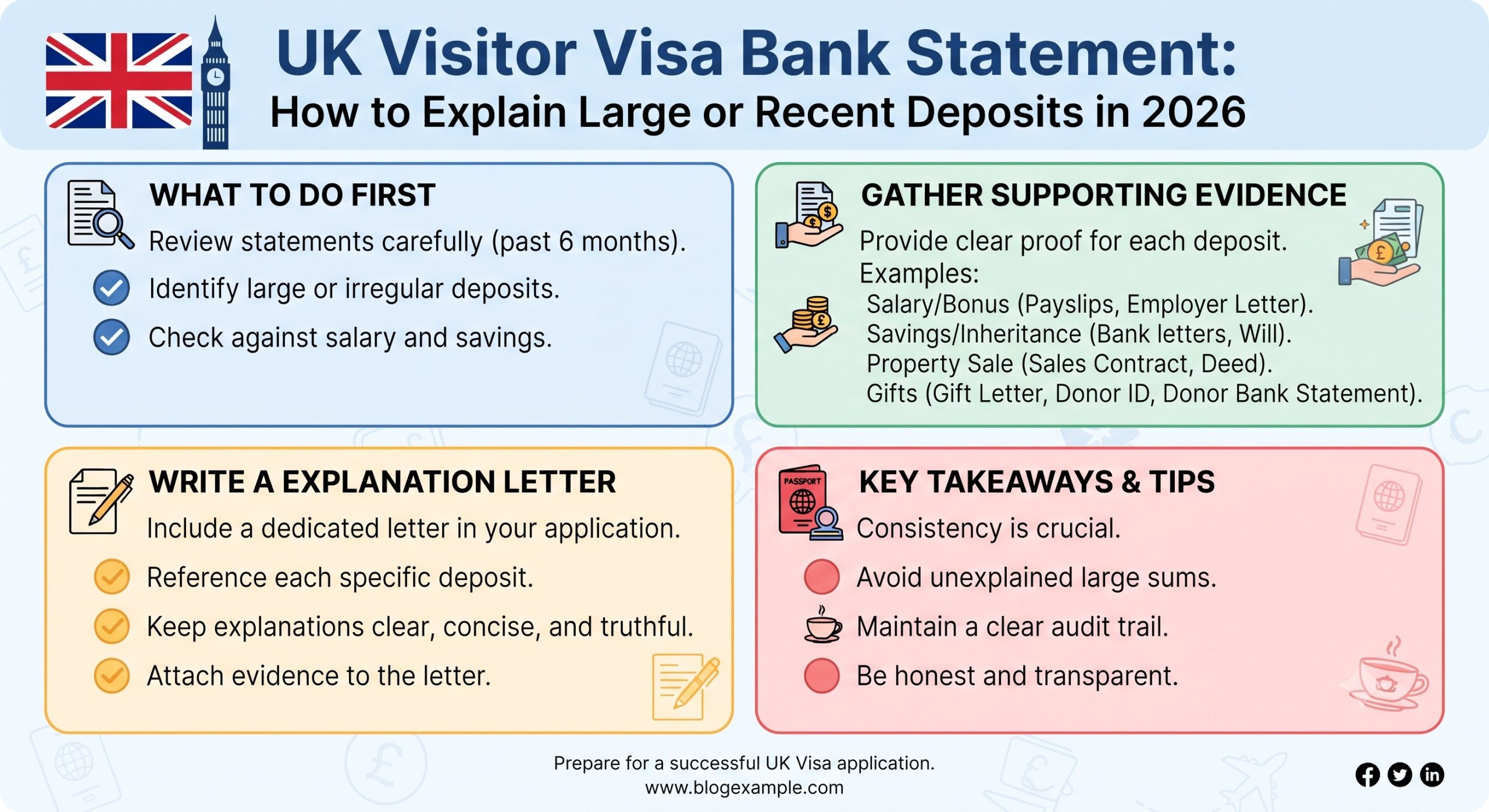
Use this simple five-step approach:
Mention the date and amount.
State exactly where the money came from.
For example, a fixed deposit matured, property was sold or an investment was redeemed.
Explain whether the money is part of your available savings or is being used for the proposed trip.
Where appropriate, provide documentation that connects the source to the bank transaction.
For example:
“The credit of ₹6,50,000 on 10 August 2026 represents the maturity proceeds of my fixed deposit. The relevant fixed-deposit maturity document and bank transaction are included with my financial evidence.”
This is much stronger than simply writing:
“I received ₹6.5 lakh recently.”
The first statement explains what happened, why it happened and how it can be verified.
1.Fixed Deposit Maturity
Fixed deposits are common among Indian savers.
If a fixed deposit matures shortly before your application and the proceeds enter your savings account, the transaction may create a significant increase in your balance.
You can connect the transaction using documents such as:
The objective is to show:
Selling property can produce a substantial one-time payment.
If you are relying on those funds, explain the transaction accurately and provide relevant documentation where available, such as:
Do not describe property-sale proceeds as monthly salary or ordinary savings.
An investment redemption can also explain a sudden increase in savings.
For example:
Investment → redemption → funds transferred to bank account
Relevant evidence could include an investment statement, redemption confirmation and the corresponding bank transaction.
A large credit may result from:
In such cases, documents such as salary slips, employer correspondence or payroll records may help establish the source.
Your declared salary and employment details should remain consistent with your supporting documents.
Self-employed applicants may naturally have larger or irregular transactions.
If a significant deposit represents a genuine business payment, explain it as business income rather than personal savings.
Depending on your circumstances, relevant evidence could include:
The key is consistency between your business activity, declared income and banking records.
This is very common.
For example, you may have ₹8 lakh across two personal accounts and move ₹6 lakh into the account you intend to use for your UK trip.
The receiving account will show a large recent credit.
If relevant, show the transaction trail:
Your Account A → ₹6 lakh transfer → Your Account B
The purpose is to demonstrate that the money was already part of your genuine financial resources rather than newly borrowed money.
Do not unnecessarily move money between accounts simply to make your statement look stronger.
A family member may provide financial support for your UK visit where the applicable Visitor requirements are satisfied.
UKVI’s supporting-document guidance says that where someone else provides travel, maintenance or accommodation, evidence should explain what support is being provided, how it is being provided, the relationship between the applicant and sponsor, and that the sponsor has sufficient funds. (GOV.UK)
For example, if your father transfers ₹5 lakh to help finance your trip, do not describe the amount as your salary.
Instead, explain the genuine family-support arrangement and provide relevant evidence.
Depending on the circumstances, this may include:
If a large transaction is significant to your financial position or unusual compared with your normal banking activity, a short explanation can be useful.
The cover letter should provide context, not replace documentary evidence.
A simple format is:
| Detail | Example |
| Date | 10 August 2026 |
| Amount | ₹6,50,000 |
| Source | Fixed-deposit maturity |
| Reason | Personal investment matured |
| Evidence | FD maturity document + bank transaction |
Keep the explanation factual and concise.
Bluebird Next already has a separate guide on how to write a UK Visitor Visa cover letter, so this article focuses specifically on explaining financial transactions rather than duplicating the full cover-letter topic. (Bluebird Next)
There is no universal UKVI rule requiring exactly six months of bank statements for every Standard Visitor applicant.
The official supporting-document guidance instead focuses on evidence showing access to sufficient funds and, where relevant, the origin of those funds. (GOV.UK)
Therefore, don’t rely on an unofficial “six-month rule” or assume that simply providing a certain number of months automatically solves a financial concern.
The more important question is whether your evidence provides a clear picture of your genuine financial circumstances.
Common Mistakes to Avoid
Do not temporarily borrow money just to make your bank balance appear higher.
If the money is legitimate, explain its source rather than leaving an important transaction unexplained.
A property sale, investment redemption, family gift and business payment are different sources.
Your application form, bank statement, salary documents, tax records and sponsor evidence should not contradict each other.
UKVI specifically expects a correlation between declared financial information and supporting evidence. (GOV.UK)
Never create or alter bank statements, salary slips, property documents or other evidence.
A high closing balance does not automatically establish that you can credibly afford the proposed trip.
Before submitting your application, ask:
The official UKVI guidance also states that financial documents should clearly demonstrate access to the funds, including bank statements that detail the origin of funds. (GOV.UK)
Can a large recent deposit cause a UK Visitor Visa refusal?
Not automatically. However, UKVI may make further checks where most or all of the funds relied upon have not been held for long, particularly to establish their origin. (GOV.UK)
How much bank balance is required for a UK Visitor Visa from India?
There is no universal fixed minimum bank balance. Your funds should be sufficient for the reasonable costs of your proposed visit. (GOV.UK)
Can I use property-sale money for my UK Visitor Visa?
Potentially, yes. If the proceeds are genuinely available to you, explain the property transaction and provide relevant evidence connecting the transaction to the bank credit.
Can I use fixed-deposit maturity money?
Yes, where the funds are genuinely available to you. If the maturity created a recent large credit, relevant fixed-deposit and bank records can help explain the transaction.
Can my parents or spouse fund my UK trip?
Third-party support can be used where the relevant Visitor requirements are satisfied. The relationship, nature of support and sponsor’s financial ability should be clearly evidenced where applicable. (GOV.UK)
Is a six-month bank statement mandatory?
There is no universal six-month requirement for every Standard Visitor application. The evidence should be appropriate to your circumstances and demonstrate access to sufficient funds and, where relevant, their origin. (GOV.UK)
Should I wait before applying after receiving a large deposit?
There is no general rule requiring a legitimate deposit to remain in your account for a specific number of days before applying. If the money is genuine, focus on documenting and explaining its source.
Does a high bank balance guarantee a UK Visitor Visa?
No. Financial evidence is only one part of the assessment. Applicants must also satisfy the genuine visitor requirements, including the intention to leave the UK and the requirement to have sufficient funds for the visit. (GOV.UK)
Final Takeaway
When preparing a bank statement for a UK Visitor Visa, don’t focus only on the final balance.
Focus on the story behind the money.
If ₹8 lakh was recently credited to your account, the important questions are:
Where did it come from? Why did you receive it? Can you prove it? Does it match your application?
If the money came from a legitimate source such as a fixed-deposit maturity, property sale, investment redemption, business income, salary bonus or genuine family support, explain the transaction accurately and provide relevant evidence.
The current UKVI guidance is clear that financial documents should demonstrate access to funds and, where relevant, their origin. It also tells caseworkers to consider large deposits and investigate the source where substantial funds have not been held in an account for long. (GOV.UK)
For broader family-finance guidance, you can also read Bluebird Next’s existing UK Visitor Visa for Family of 4: Financial Requirements & Documents 2026. (Bluebird Next)
If you want step-by-step help with your UK Visitor Visa application, Bluebird Next also offers a UK Tourist Visa Training Program covering financial proof, application forms, travel plans, cover letters and supporting documents. (Bluebird Next)
Need help with your application? Bluebird Next can help you organise your financial evidence, identify transactions that may require clarification and present your genuine circumstances clearly.
Important: No consultant can guarantee a UK visa. The final decision is made by UK Visas and Immigration based on the individual application and evidence.
Official Sources

October 22, 2026

October 19, 2026

October 16, 2026

October 12, 2026

October 10, 2026